How to Calculate Artificial Grass Density: Formula, Gauge & Stitch Rate
Artificial grass density is one of the most important specifications to understand when comparing synthetic turf products. However, many buyers are confused by terms such as gauge, stitch rate, stitches per square meter, tufts per square meter, Dtex, and face weight.
A product may have a high stitch rate but a relatively wide gauge. Another product may have a narrower gauge but a lower stitch rate. So how can you calculate the actual density?
The good news is that the calculation is relatively simple when the units are clearly defined.
In this guide, we will explain what artificial grass density means, how to calculate it from gauge and stitch rate, how to convert different units, and why density alone should not be used to determine turf quality.
We will also provide practical calculation examples for different artificial turf constructions.
What Is Artificial Grass Density?
Artificial grass density generally refers to the number of tufts or stitches distributed over one square meter of turf.
It is commonly expressed as:
Stitches/m²
or
Tufts/m²
For example, if an artificial grass product has a density of:
18,900 stitches/m²
this means that approximately 18,900 stitch points or tufts are distributed across one square meter of turf.
A higher number generally means that the turf has more tuft points and a more closely packed construction. However, a higher density does not automatically mean better artificial grass.
The yarn's Dtex, pile height, face weight, yarn shape, polymer, backing and application must also be considered.
Technical specifications used in synthetic turf testing can separately report properties such as pile height, pile weight, stitch gauge, tufts/m² and yarn linear density (Dtex), which is another reason buyers should not treat these measurements as interchangeable.
What Is the Difference Between Tufts, Stitches and Filaments?
These terms are sometimes used incorrectly, especially in online product descriptions.
Tuft
A tuft is a bundle of yarn inserted into the backing.
Stitch
A stitch refers to an insertion point along a row of tufting.
Depending on the manufacturer's terminology, a stitch can represent a tufting point.
Filament
A filament is an individual strand within the yarn.
One tuft may contain multiple filaments.
Therefore:
Tufts/m² ≠ Filaments/m²
For example, if a turf has:
-
18,900 tufts/m²
-
24 filaments per tuft
the number of individual filaments can be much higher than 18,900.
This distinction is important when comparing artificial turf specifications.
What Is Stitch Rate in Artificial Grass?
Stitch rate describes how many stitches are made along a specific length of the turf.
The most common units include:
-
stitches per 10 cm
-
stitches per meter
-
stitches per 3 inches
-
stitches per foot
For example:
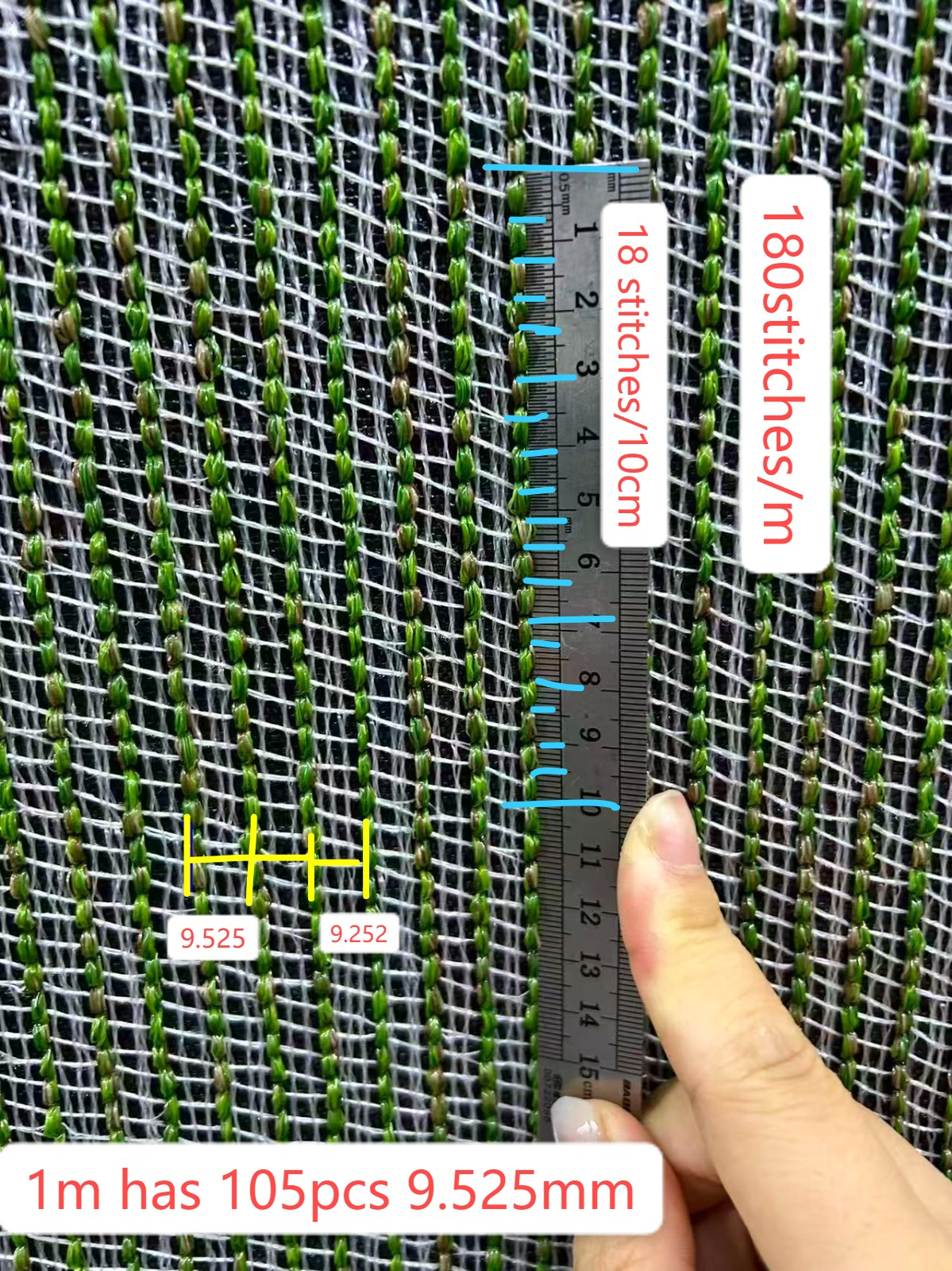
18 stitches/10 cm
means there are approximately 18 stitch points within every 10 cm along the tufting row.
Because one meter contains ten 10-cm sections:
18 × 10 = 180 stitches/m
Therefore:
18 stitches/10 cm = 180 stitches/m
Another example:
17 stitches/10 cm = 170 stitches/m
Always check the unit before using the number in a density calculation.
A stitch rate without a clearly stated measurement length can be misleading when comparing different products. Modern technical guides also emphasize that the denominator should be identified when interpreting stitch rate.
What Is Gauge in Artificial Grass?
Gauge refers to the spacing between adjacent rows of tufting.
It is usually expressed in inches.
Common artificial grass gauges include:
-
3/8 inch
-
5/8 inch
-
3/4 inch
-
1/2 inch
A smaller gauge means that the rows are closer together.
For example:
3/8 inch gauge
has closer row spacing than:
5/8 inch gauge
Therefore, if two products have the same stitch rate, the product with the narrower gauge will generally have a higher number of stitches or tufts per square meter.
How to Calculate Artificial Grass Density
The basic principle is:
Density = Number of tufting rows per meter × Stitch rate per meter
To calculate the density accurately, you need two pieces of information:
-
Gauge
-
Stitch rate
Step 1: Convert Gauge Into Millimeters
One inch equals:
25.4 mm
For a 3/8 inch gauge:
3/8 × 25.4 = 9.525 mm
So a 3/8 inch gauge is approximately:
9.53 mm
Step 2: Calculate the Number of Rows per Meter
One meter equals:
1,000 mm
Therefore:
Rows per meter = 1,000 ÷ Gauge in mm
For a 3/8 inch gauge:
1,000 ÷ 9.525 = 104.99
So there are approximately:
105 rows/m
Step 3: Convert Stitch Rate to Stitches per Meter
Suppose the stitch rate is:
18 stitches/10 cm
Convert it to stitches per meter:
18 × 10 = 180 stitches/m
Step 4: Multiply Rows by Stitch Rate
Now calculate:
105 rows/m × 180 stitches/m
= 18,900 stitches/m²
Therefore:
A 3/8 inch artificial turf with 18 stitches/10 cm has approximately 18,900 stitches/m².
This calculation method is also consistent with published artificial turf density examples using gauge and stitch rate.
Artificial Grass Density Formula
For quick reference, the formula is:
Density (stitches/m²) = Rows per meter × Stitch rate per meter
Where:
Rows per meter = 1,000 ÷ Gauge (mm)
And:
Stitch rate per meter = Stitch rate per 10 cm × 10
Therefore:
Density = [1,000 ÷ Gauge (mm)] × Stitch rate per meter
If gauge is expressed in inches, you can use:
Density = [1,000 ÷ (Gauge × 25.4)] × Stitch rate per meter
Artificial Grass Density Calculation Examples
Let's look at several practical examples.
Example 1: 3/8" Gauge, 18 Stitches/10 cm
Specifications:
-
Gauge: 3/8"
-
Stitch rate: 18 stitches/10 cm
Convert gauge:
3/8 × 25.4 = 9.525 mm
Rows per meter:
1,000 ÷ 9.525 = 104.99
Convert stitch rate:
18 × 10 = 180 stitches/m
Density:
104.99 × 180 = 18,898
Rounded:
Approximately 18,900 stitches/m²
Example 2: 3/8" Gauge, 20 Stitches/10 cm
Specifications:
-
Gauge: 3/8"
-
Stitch rate: 20 stitches/10 cm
Rows:
1,000 ÷ 9.525 = 104.99 rows/m
Stitch rate:
20 × 10 = 200 stitches/m
Density:
104.99 × 200 = 20,998
Therefore:
Approximately 21,000 stitches/m²
Increasing the stitch rate from 18 to 20 stitches per 10 cm increases the calculated density from approximately 18,900 to 21,000 stitches/m².
Example 3: 5/8" Gauge, 18 Stitches/10 cm
Now consider a wider gauge.
Specifications:
-
Gauge: 5/8"
-
Stitch rate: 18 stitches/10 cm
Convert gauge:
5/8 × 25.4 = 15.875 mm
Rows:
1,000 ÷ 15.875 = 62.99 rows/m
Stitch rate:
18 × 10 = 180 stitches/m
Density:
62.99 × 180 = 11,338
Therefore:
Approximately 11,340 stitches/m²
This example demonstrates why stitch rate alone cannot tell you the density.
Both products may have:
18 stitches/10 cm
but:
-
3/8" gauge → approximately 18,900 stitches/m²
-
5/8" gauge → approximately 11,340 stitches/m²
The gauge makes a major difference.
Artificial Grass Density Comparison Table
| Gauge | Stitch Rate | Approx. Rows/m | Approx. Density |
|---|---|---|---|
| 3/8" | 16/10 cm | 105 | 16,800 stitches/m² |
| 3/8" | 18/10 cm | 105 | 18,900 stitches/m² |
| 3/8" | 20/10 cm | 105 | 21,000 stitches/m² |
| 3/8" | 22/10 cm | 105 | 23,100 stitches/m² |
| 5/8" | 16/10 cm | 63 | 10,080 stitches/m² |
| 5/8" | 18/10 cm | 63 | 11,340 stitches/m² |
| 5/8" | 20/10 cm | 63 | 12,600 stitches/m² |
These values are theoretical calculations based on the stated gauge and stitch rate. Actual manufactured density may vary because of production tolerances and how the manufacturer defines and measures the specification.
How to Calculate Density From a Technical Datasheet
If you are buying artificial grass, you may find a specification like this:
| Specification | Value |
|---|---|
| Pile Height | 35 mm |
| Gauge | 3/8" |
| Stitch Rate | 18 stitches/10 cm |
| Dtex | 10,000 |
| Face Weight | 1,000 g/m² |
You can calculate the approximate density.
Gauge:
3/8" = 9.525 mm
Rows:
1,000 ÷ 9.525 = 105 rows/m
Stitch rate:
18 × 10 = 180 stitches/m
Density:
105 × 180 = 18,900 stitches/m²
So the theoretical density is:
18,900 stitches/m²
This is much more useful than simply seeing “18 stitches/10 cm” on a specification sheet.
How to Calculate Stitch Rate From Artificial Grass Density
You can also reverse the calculation.
Suppose you know:
-
Density = 18,900 stitches/m²
-
Gauge = 3/8"
First calculate rows per meter:
1,000 ÷ 9.525 = 105 rows/m
Then:
Stitch rate = Density ÷ Rows per meter
18,900 ÷ 105 = 180 stitches/m
Convert to stitches per 10 cm:
180 ÷ 10 = 18 stitches/10 cm
Therefore:
18,900 stitches/m² at 3/8" gauge corresponds to approximately 18 stitches/10 cm.
This reverse calculation can be particularly useful when checking whether a supplier's technical datasheet is internally consistent.
Artificial Grass Density vs. Dtex
One of the biggest mistakes buyers make is assuming that density and Dtex mean the same thing.
They do not.
Density tells you:
How many tuft points are distributed across one square meter.
Dtex tells you:
The linear mass of the yarn.
One dtex corresponds to one gram per 10,000 meters of yarn. Technical standards and test specifications use Dtex as a measure of yarn linear density.
For example:
-
8,000 Dtex
-
10,000 Dtex
-
12,000 Dtex
describe the yarn's linear density.
They do not directly tell you how many stitches are present per square meter.
Does Higher Artificial Grass Density Mean Better Quality?
Not necessarily.
This is one of the most important points for artificial turf buyers.
Imagine two products:
Product A
-
20,000 stitches/m²
-
8,000 Dtex
Product B
-
16,800 stitches/m²
-
12,000 Dtex
You cannot automatically conclude that Product A is better because it has a higher stitch count.
Product B may contain heavier yarn and have a different yarn construction.
The overall performance depends on several specifications, including:
-
Density
-
Dtex
-
Pile height
-
Face weight
-
Yarn shape
-
Yarn material
-
Filament structure
-
Primary backing
-
Secondary backing
-
Coating
-
Tuft bind
-
Intended application
In other words:
Density is one part of artificial grass quality — not the entire quality measurement.
Artificial Grass Density vs. Pile Height
Pile height is another specification that should be considered together with density.
For example, two products may both have:
40 mm pile height
but have very different densities.
A 40 mm turf with 21,000 stitches/m² will have a different construction from a 40 mm turf with 12,000 stitches/m².
However, the higher-density product is not automatically the better choice.
For a landscaping project, softness and appearance may be important.
For a football field, ball interaction, resilience, yarn durability and system performance may be more important.
For a playground, safety and shock absorption may be more important.
The correct specification depends on the application.
What Is a Good Artificial Grass Density?
There is no single density that is ideal for every application.
Instead, density should be selected according to the intended use.
Landscaping Artificial Grass
For gardens, balconies, terraces and decorative landscaping, buyers often prioritize:
-
Natural appearance
-
Softness
-
Yarn shape
-
Color
-
Pile height
-
Density
A balanced construction is generally more important than simply choosing the highest possible stitch count.
Playground Artificial Grass
For playground applications, density is only one factor.
You should also consider:
-
Safety requirements
-
Shock absorption system
-
Pile height
-
Yarn durability
-
Backing
-
Drainage
-
Infill system
The turf should be evaluated as part of the complete playground surface system.
Football Artificial Grass
Football turf requires a more comprehensive technical evaluation.
Important specifications include:
-
Pile height
-
Gauge
-
Stitch rate
-
Density
-
Dtex
-
Face weight
-
Yarn profile
-
Tuft bind
-
Backing
-
Infill
-
Shock pad where applicable
-
Drainage
-
System performance
For sports turf, simply choosing the product with the highest density is not an adequate purchasing strategy.
Sports turf standards and testing frameworks also evaluate multiple properties beyond stitch count, including yarn characteristics, pile weight, tuft anchorage and other construction parameters.
How to Read an Artificial Grass Technical Datasheet
When comparing two artificial turf products, do not look at only one number.
A useful comparison table should include:
| Specification | Product A | Product B |
|---|---|---|
| Pile Height | 35 mm | 35 mm |
| Gauge | 3/8" | 5/8" |
| Stitch Rate | 18/10 cm | 18/10 cm |
| Density | 18,900/m² | 11,340/m² |
| Dtex | 10,000 | 12,000 |
| Face Weight | Compare | Compare |
| Yarn Shape | Compare | Compare |
| Backing | Compare | Compare |
| Application | Landscape | Sports |
This gives buyers a much clearer picture than comparing only:
“20,000 stitches vs. 18,000 stitches.”
A Simple Artificial Grass Density Calculator
You can calculate artificial grass density using the following formula:
Step 1
Enter the gauge in inches.
Step 2
Convert gauge to millimeters:
Gauge × 25.4
Step 3
Calculate rows per meter:
1,000 ÷ Gauge in mm
Step 4
Convert stitch rate:
Stitches/10 cm × 10 = Stitches/m
Step 5
Calculate density:
Rows/m × Stitches/m = Stitches/m²
Quick Formula
If the gauge is in inches and stitch rate is given per 10 cm:
Density = [1,000 ÷ (Gauge × 25.4)] × (Stitch Rate × 10)
For example:
Gauge = 3/8"
Stitch rate = 18 stitches/10 cm
Therefore:
Density = [1,000 ÷ (0.375 × 25.4)] × (18 × 10)
≈ 18,900 stitches/m²
Important: Theoretical Density vs. Measured Density
The formula gives you an estimated or theoretical density based on the specified gauge and stitch rate.
The actual manufactured product can have tolerances.
For this reason, a technical datasheet may show a declared density that is not exactly identical to a simple calculation.
For commercial purchasing, especially for large sports projects, it is better to verify the manufacturer's technical datasheet and, where necessary, independent test results.
Some synthetic turf standards specify tolerances for properties such as tufts per square meter, gauge and yarn linear density.
Common Mistakes When Calculating Artificial Grass Density
Mistake 1: Using Stitch Rate Alone
For example:
18 stitches/10 cm
This does not tell you the density unless you also know the gauge.
Mistake 2: Ignoring the Unit
These are not the same:
-
18 stitches/10 cm
-
18 stitches/m
-
180 stitches/m
Always identify the unit.
Mistake 3: Confusing Dtex With Density
Dtex measures yarn linear density.
Stitches/m² measures tufting density.
They describe different characteristics.
Mistake 4: Assuming Higher Density Always Means Better Turf
A higher stitch count can increase fullness, but overall turf performance depends on the complete construction.
Mistake 5: Comparing Different Gauges Without Conversion
A 3/8" turf and a 5/8" turf cannot be fairly compared based only on their stitch rates.
Calculate the approximate stitches/m² first.
Frequently Asked Questions
What is artificial grass density?
Artificial grass density generally refers to the number of tufts or stitches distributed across one square meter of turf, commonly expressed as stitches/m² or tufts/m².
How do you calculate artificial grass density?
Multiply the number of tufting rows per meter by the stitch rate per meter.
Density = Rows/m × Stitches/m
What is the formula for 3/8" artificial grass density?
For 3/8" gauge, there are approximately 105 rows per meter.
Therefore:
Density ≈ 105 × Stitch Rate per Meter
For 18 stitches/10 cm:
105 × 180 ≈ 18,900 stitches/m²
Is 18,900 stitches/m² good artificial grass?
18,900 stitches/m² is a commonly encountered density level, but whether it is suitable depends on the application, pile height, Dtex, yarn construction, backing and other specifications.
Is higher artificial grass density better?
Not necessarily. Density should be evaluated together with Dtex, face weight, pile height, yarn shape, backing and the intended application.
What is the difference between Dtex and density?
Dtex measures the linear mass of yarn, while density measures the number of tuft or stitch points over a given area.
What is the difference between 3/8" and 5/8" gauge?
3/8" has closer tufting rows than 5/8". Therefore, with the same stitch rate, 3/8" generally produces a higher number of stitches per square meter.
How many stitches per square meter is artificial turf?
There is no universal number. Artificial turf products can have different densities depending on their application and construction. The correct density should be evaluated together with the other technical specifications.
How can I check whether an artificial grass specification is correct?
Check the gauge, stitch rate and stated density. Calculate the theoretical density and compare it with the manufacturer's declared specification. Also consider production tolerances and the measurement method.
Does pile height affect artificial grass density?
Pile height and density are separate specifications, although manufacturers may design them together. A higher pile does not automatically mean higher density.
Final Thoughts
Calculating artificial grass density is straightforward once you understand the relationship between gauge and stitch rate.
The basic calculation is:
Density = Rows per meter × Stitch rate per meter
For example:
3/8" gauge + 18 stitches/10 cm
gives approximately:
18,900 stitches/m²
However, density should never be the only specification used to evaluate artificial turf.
For a professional comparison, always consider:
Gauge + Stitch Rate + Density + Dtex + Pile Height + Face Weight + Yarn Structure + Backing + Application
Understanding these specifications allows buyers, contractors and distributors to compare artificial turf products more accurately and avoid choosing a product simply because one number looks higher.
If you are comparing artificial grass for a garden, landscaping project, playground, football field or padel court, the best specification is the one that provides the right balance between density, yarn construction, durability, appearance and application requirements.